







Venezuela Rejects Guyana Claims, Reiterates Esequibo Defense
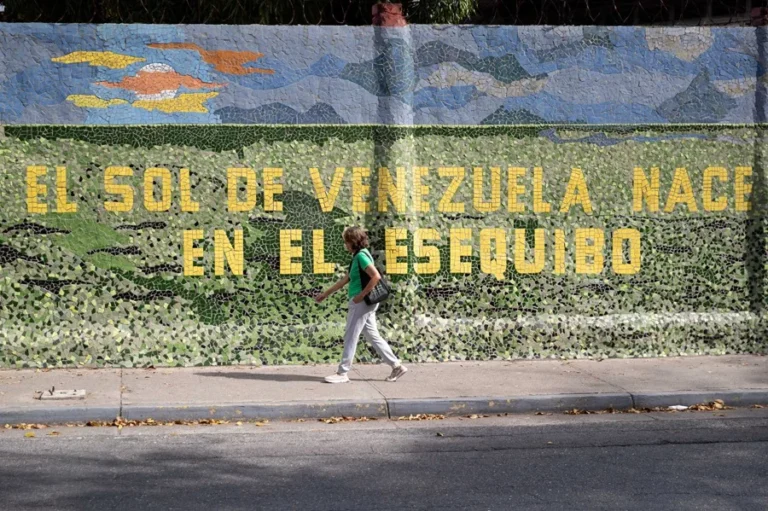
Venezuela affirms that the Geneva agreement remains the only valid and current legal instrument to reach a practical, satisfactory and mutually acceptable solution for both nations through direct bilateral negotiations. Photo: EFE.
May 27, 2026 Hour: 5:46 pm
🔗 Comparte este artículo
Venezuela categorically rejected recent provocative statements made by Guyanese President Irfaan Ali during his nation’s 60th independence anniversary celebrations.
Venezuela reaffirmed its unwavering defense of historical rights over the Guayana Esequibo territory, asserting it will never renounce its legitimate claim, underscoring that the 1966 Geneva Agreement remains the sole valid and current legal instrument to achieve a practical, satisfactory, and mutually acceptable solution for both nations through direct bilateral negotiations.
RELATED: Venezuela Restructures Government Management, Popular Consultation Organized
Colonial Legacy
Venezuela firmly condemned President Irfaan Ali’s unsubstantiated assertions that the Guayana Esequibo territory exclusively belongs to Guyana and was never under Spanish or Venezuelan sovereignty. These declarations, made on May 27, during the anniversary of Guyana’s independence, were deemed a deliberate falsification of historical and legal truth by the Venezuelan Government.
In response to these claims, FM Yván Gil emphasized that the Bolivarian Government remains committed to seeking a just and peaceful resolution through direct diplomatic channels. He highlighted that the territorial dispute is a direct consequence of British colonialism, a legacy that continues to impact the sovereignty of the entire region. In this sense, Gil underscored that the dispossession of Esequibo constitutes an inheritance of the British Empire’s imperial practices, from which Guyana eventually gained its independence.
Text reads: “Communiqué: The Bolivarian Republic of Venezuela categorically rejects the provocative and delirious statements issued by the President of the Cooperative Republic of Guyana, Irfaan Ali, from the territory of Guayana Esequiba, area under his administration as a result of the fraudulent dispossession of historically Venezuelan territory executed by the United Kingdom.”
Caracas further characterized Georgetown’s pronouncements as a distortion of facts, reiterating that the Esequibo area is currently under Guyanese administration as a result of a fraudulent historical dispossession. This illicit appropriation was executed by the British Empire through the 1899 Paris Arbitral Award, a ruling that was formally superseded and invalidated by both parties upon the signing of the 1966 Geneva Agreement.
Venezuela vehemently emphasized that it never granted its consent to the tribunal that issued the 1899 Arbitral Award, arguing that Guyana’s unilateral presentation of the claim directly violated the spirit and purpose of the 1966 treaty. The Venezuelan Government has consistently maintained that the 1899 Paris Arbitral Award was a fraudulent judgment, orchestrated to favor British colonial interests, and thus holds no legal validity in resolving the ongoing territorial dispute.
Geneva Accord Key
The 1966 Geneva Agreement stands as the definitive and only valid legal instrument for achieving a practical, satisfactory and mutually acceptable solution for both Venezuela and Guyana. This accord specifically calls for direct bilateral negotiations to resolve the existing territorial dispute peacefully.
The official Venezuelan document released on this occasion explicitly ratified that Venezuela will never relinquish its legitimate historical rights over the Guayana Esequibo. The nation pledges to continue its unrestricted defense of these rights through all pertinent diplomatic channels, political forums, and legal mechanisms available under international law.
Authorities in Caracas have consistently urged the Guyanese Government to honor its international obligations by engaging in face-to-face, good-faith negotiations. Such a peaceful resolution must fully respect the principle of sovereignty and the territorial integrity of the entire region.
Venezuela’s firm stance reflects its commitment to decolonization and the pursuit of justice regarding a territory it considers historically its own, highlighting the consequences of colonialism and advocating for peaceful resolution through dialogue and respect for international agreements.
Author: Laura V. Mor
Source: Venezuelan Presidential Press